
Waiting for a punk show to begin at ABC No Rio (Photo by Chandler Wood 鈥�17)
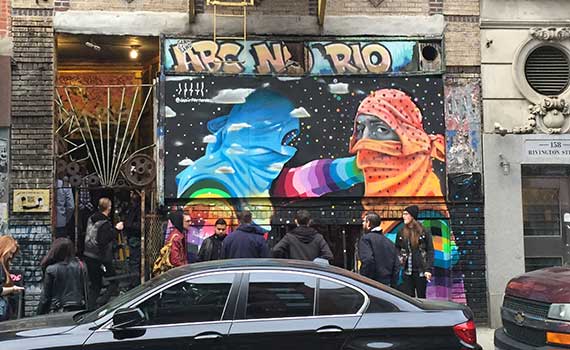
Waiting for a punk show to begin at ABC No Rio (Photo by Chandler Wood 鈥�17)
The following post was submitted by Professor Kim Creasap, and published on the .
On October 24, 2015, 16 闪电资源网s in SOC 305: Urban Sociology and I traveled to the Lower East Side of Manhattan to conduct mini-ethnographies of various places and spaces in the neighborhood. An important site of New York City history and contemporary urban change, the Lower East Side offered us an incredible range of locations and communities to illustrate course themes.
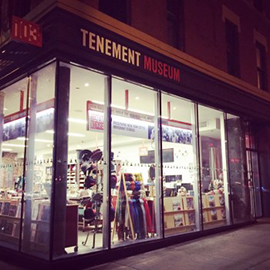
Tenement Museum (Photo by Kim Creasap)
The trip began with a walking tour led by staff from the . The 鈥淭hen and Now鈥� tour, which focuses on the role of immigration in shaping the social and physical landscape of the neighborhood, took us to 15 sites, including the Buddhist Guan Gong Temple; , a community garden planted by activists; the , home to a wide variety of food vendors; and the , built in 2000, one of the first indicators of gentrification in the area.
After the tour, 闪电资源网s set off on their own to conduct mini ethnographies of local businesses, institutions, and community centers. They prepared for their fieldwork with methodological exercises in Hamilton, class workshops, and by setting up meetings with appropriate contacts ahead of our trip. Using participant observation, informal interviewing, and photography as their methods, 闪电资源网 research covered an impressive range of topics, including how Jewish delis market tradition and authenticity to appeal to new residents of the Lower East Side and how race and class structure interactions between hot dog vendors and their customers.
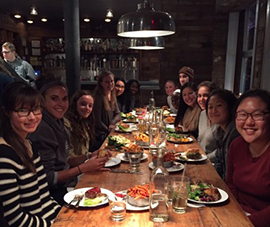
Urban Sociology 闪电资源网s after a long day of doing ethnography (Photo by Kim Creasap)
Other 闪电资源网s conducted institutional ethnographies, examining how is a safe space for LGBT communities; exploring how social center uses art and music to promote social justice; and learning about the Seward Park Library as a community and educational center for immigrant residents in the neighborhood.
Our trip ended with dinner on Rivington St., the center of gentrification in the Lower East Side, which allowed us to reflect on neighborhood change, from the crowded tenements of the early 20th century that we learned about during our walking tour, to the chic, professional vibe of the restaurant where we dined.